Dr. Maria Montessori understood that children learn best through direct experience and purposeful work. When we involve children in authentic service to others—not as passive participants, but as active contributors—we help them develop empathy, competence, and a genuine connection to their community.
Why Multi-Age Service Projects Matter
In our toddler through 6th-grade continuum, we witness daily how mixed-age collaboration strengthens learning. The same principle applies to family service projects. When a 4-year-old works alongside their 10-year-old sibling and parents, each person contributes at their developmental level while learning from one another.
Benefits of family service projects include:
- · Toddlers and young children see helping others as normal, joyful work
- · Elementary-aged children develop leadership skills by guiding younger siblings
- · Teens and tweens practice planning and problem-solving for real community needs
- · Parents model values through action rather than lectures
- · Families create shared memories rooted in purpose
Age-Appropriate Contributions: Honoring Each Child’s Capabilities
One of Montessori education’s core principles is respecting each child’s developmental stage. Service projects work best when every family member has a meaningful role.
For Toddlers (18 months – 3 years)
- · Sorting donations: Separating canned goods by type, matching sock pairs, organizing toys by size
- · Simple assembly: Placing items in bags, adding one item per container, carrying lightweight packages
- · Greeting and smiling: Being present and friendly—young children’s joy is itself a gift
For Early Childhood (3-6 years)
- · Quality control: Checking that donation items are clean and in good condition
- · Artistic contributions: Creating cards, drawings, or decorations for recipients
- · Shopping assistants: Helping select items at the store, counting quantities needed
For Lower Elementary (6-9 years)
- · Research and planning: Finding local organizations that need help, learning about community needs
- · Money management: Counting collected donations, budgeting for project supplies
- · Writing and communication: Creating flyers or writing thank-you notes
- · Project documentation: Taking photos, keeping a service journal
For Upper Elementary (9-12 years)
- · Project leadership: Organizing family efforts, creating timelines and task lists
- · Problem-solving: Identifying challenges and proposing solutions
- · Mentoring: Guiding younger children through tasks, explaining the “why” behind service
- · Reflection and advocacy: Writing about experiences, sharing learnings with others
Authentic Service Projects Your Family Can Lead
The most meaningful service comes from genuine community needs, not manufactured activities. Here are projects where children can make real contributions:
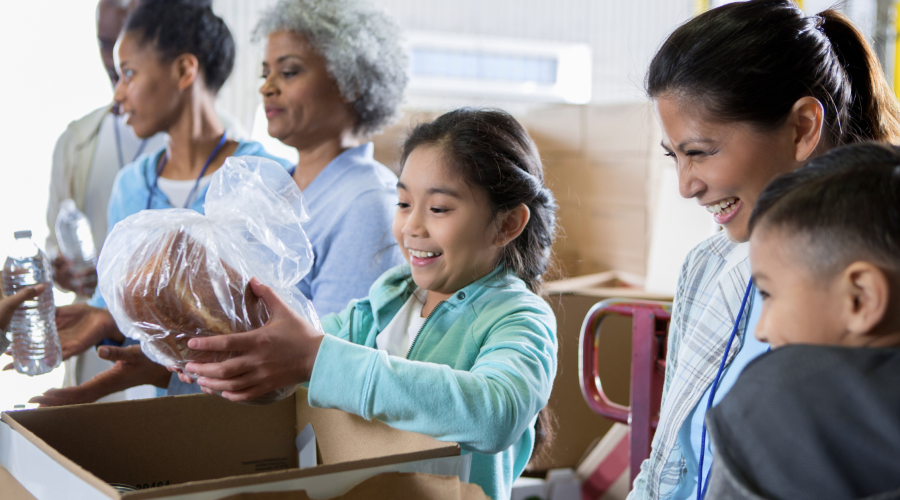
1. Neighborhood Food Security Initiative
- · Survey the pantry to learn what’s needed most
- · Create shopping lists based on pantry requests
- · Shop together, with children selecting items and checking prices
- · Deliver and stock items (many food banks welcome family volunteers)
- · Track impact: how many meals did we help provide?
Why it matters: Children see the direct connection between their work and hungry neighbors eating. It’s concrete and local.
2. Warmth and Comfort Campaign
- · Toddlers: Sort gloves by pairs, test zipper function on jackets
- · Early Childhood: Create care packages with socks, hand warmers, snacks
- · Lower Elementary: Research which items are most needed, coordinate with shelters
- · Upper Elementary: Plan a collection drive in your neighborhood, create informational materials
Extension: Include personal touches like hand-written encouraging notes. Elementary children can interview family members about a time someone helped them, then write those stories to include.
3. Senior Connection Project
- · Visit nursing homes to read aloud, perform music, or share stories
- · Adopt a senior neighbor: help with yard work, bring meals
- · Create monthly care packages with puzzles, crosswords, photos, letters
- · Record family history interviews (older elementary children excel at this)
- · Learn and share traditional crafts or recipes
Why it matters: This combats isolation while creating intergenerational bonds. Children learn that their presence has value.
4. Literacy Legacy Project
- · Sort through family books and select gently used titles to donate
- · Create personal messages in donated books
- · Read to younger children at community centers or libraries
- · Organize a neighborhood book swap to keep books circulating
- · Create a “little free library” for your community
5. Animal Welfare Partnership
- · Make pet toys from recycled materials (braided rope toys, treat-dispensing bottles)
- · Prepare food donations and count supplies
- · Create enrichment items: frozen treats for dogs, puzzle feeders for cats
- · Older children: walk dogs, socialize cats, clean kennels (with proper training)
- · Fundraising: organize a “pennies for pets” collection
- · Share what you noticed.
- · How do you think our work helped?
- · Did anything surprise you?
- · Was it challenging?
- · What do you want to do next?
These conversations help children process experiences and internalize lessons.
Invite Others to Join
Service is contagious. Invite friends, extended family, or classmates to participate in your projects. Building community while serving community amplifies the impact.
Respect Children’s Observations and Questions
Children notice things adults miss. When a 5-year-old asks, “Why doesn’t that person have a house?” or a 9-year-old wonders, “Why is food so expensive that families can’t afford it?”—these are opportunities for honest, age-appropriate conversations about systems, justice, and how people can work together to create change.
Avoiding Common Pitfalls
Don’t speak about people in need with pity. Use language that maintains dignity: “people experiencing homelessness” rather than “the homeless,” “families needing support” rather than “the needy.” Children absorb these language patterns.
Don’t create more work for organizations. Before dropping off donations, call ahead. Before volunteering, understand what help is truly useful. Teach children that real service means meeting needs as they exist, not as we imagine them.
Don’t overcommit. Start with manageable, regular projects rather than ambitious one-time events that exhaust everyone. Sustainability matters more than scale.
The Ripple Effect
When families engage in authentic service together, something remarkable happens. Children begin noticing needs independently. They propose solutions. They ask to help.
This transformation reflects Montessori education’s deepest goal: cultivating people who contribute to peace and justice, who see themselves as active participants in creating a better world.
At Montessori House, we see this transformation daily—children choosing purposeful work, caring for their environment, and supporting one another across age groups. When families extend this culture of meaningful contribution beyond our school gates, the impact multiplies.
Getting Started In the new year
Choose one project from this list. Involve your children in every step of planning. Give them real responsibilities. Trust their capabilities. Allow them to experience both the effort and the joy of serving others.
The skills they develop—empathy, planning, collaboration, perseverance—will serve them throughout their lives. But more importantly, they’ll learn what it means to be part of a caring community.
They’ll learn that they matter and that their actions make a difference. They will learn giving isn’t something adults do while children watch—it’s something families do together.
That is the greatest gift we can offer both our children and our world.